


There are no more items in your cart

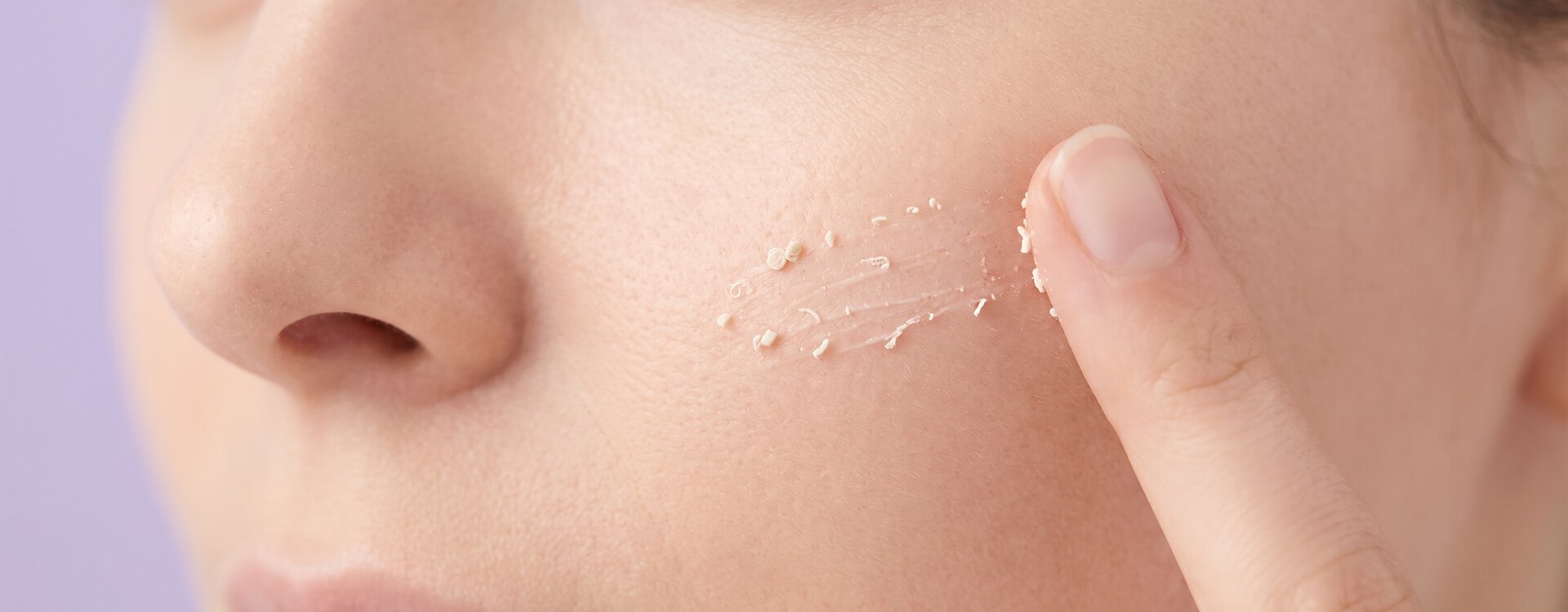
Serum on your face, cream over it, a few more strokes and you're done. Then tiny crumbs start forming under your fingers. Whitish, like when you rub out a pencil line with an eraser. The more you rub, the more of them there are.
Your first thought is that something is wrong with the cream.
Maybe it's the combination that's wrong.
This is called pilling. It happens when what you've put on your face doesn't stay evenly spread and instead gathers into visible particles. The American online dermatology service Telederm writes in its guide that this isn't necessarily a sign of a poor product, and that no single chemical reaction explains every case of pilling. So there isn't just one solution either. The same causes do keep coming up, though, and you can try fixing many of them without buying anything new.
A cream may contain water, oils, emulsifiers, moisture-binding ingredients and thickeners. When you spread it, those ingredients don't all behave the same way. Some enter the upper layers of the skin and some stay on the surface. Water and other volatile ingredients evaporate, so what remains can become more concentrated or form a thin film.
Then a new product goes over that film. Or your fingers, still rubbing. The film can be disturbed and the residue can gather into crumbs. This is one possible explanation, and how accurate it is depends on the products you use.
Those crumbs may contain ingredients from one or more of the products you've applied. It can also happen that the skin itself peels, when it has been over-exfoliated. Dermatologist Mona Gohara joked to Allure magazine that her products pill when she overdoes her retinol, because her skin peels off in little balls, moisturiser and all.
Face wash, toner, essence, serum, cream, primer, sunscreen, foundation. Each of these products can be well made. How they will all behave together can't always be predicted.
That exact combination on your skin hasn't necessarily been tested by anyone. I wrote more about this in the piece on the 10-step skincare routine.
Dermatologist Shari Marchbein tells Allure that too many creams or serums at once can contribute to pilling, and advises paring your routine down to what you really need. Along the way, you'll find it easier to spot which product is causing the problem.
A thick layer of serum or cream can leave excess on the surface, and that excess can roll up more easily under the next layer. Dr Gohara's advice fits into one sentence: “Use lighter products and less of them.”
With our immortelle face cream, I recommend that if it feels too rich, you apply it to wet skin in a thinner layer. You can first spritz your face with immortelle hydrosol, which makes the cream easier to spread.
One important exception. Don't skimp on sunscreen to stop it pilling, because it should be applied in the amount the instructions state. The same goes for medication prescribed by your dermatologist. If it pills, get in touch with them, and don't change the amount or the way you apply it on your own.
In the morning you have five minutes and three products. Serum, straight on to cream, straight on to foundation.
Marchbein says pilling most commonly occurs because we don't give a product enough time to dry before the next layer. Her advice is about an extra minute between layers.
Nobody can give you an exact figure, though. Telederm cautions that there is no scientifically established waiting time that works for every formula, and that waiting longer won't always rescue products that don't get along. Take that minute as a rule of thumb to start with. Make a coffee between serum and cream.
The rule dermatologists keep repeating is lightest to heaviest. Serum first, then cream.
Cosmetic chemist Ginger King explains to Allure that water-based and oil-based products don't mix well when you layer them on top of each other. Telederm gives a practical reason why water-based products usually go before oil-based ones: a rich oily layer can change how a light gel spreads over it.
The reverse isn't always trouble-free either. MB Cosmetics Academy, which teaches cosmetic formulators, describes what can happen when too many film-forming ingredients build up on the skin. Oil on top disturbs that layer and literally rolls it off the face. So apply a few drops of our oil serum with immortelle, calendula and squalane only once what's underneath has settled.
Order is still only a good starting point, not a law of chemistry. A thin gel can contain film-forming ingredients, and a thick cream can spread over other products with no trouble at all.
MB Cosmetics Academy notes that crumbs can appear when a cream is massaged into the face for too long, and that the layer that forms can break apart under friction. Sometimes the only difference between a smooth application and crumbs is how long your fingers kept passing over the same spot.
Spread it, then leave your face alone. If the crumbs have already started, don't keep rubbing them.
If you've tried all of this and the crumbs remain, it's time to test your products one by one. Apply each one alone, on clean skin. King says a product that pills by itself, with no other layers, points to the formula, and this is commonly seen in products with carbomer that hasn't been properly neutralised in the formula. Carbomer is an ingredient that gives gels their thickness.
On the ingredient list you can look for thickeners and film-forming ingredients, such as carbomer, xanthan and guar gum, acrylates and silicones like dimethicone. That doesn't mean they're bad. They are useful ingredients, and an ingredient list alone doesn't predict whether a product will pill. Silicones are especially easy to blame, and Telederm calls that explanation an oversimplification.
There's also a part that concerns us manufacturers. MB Cosmetics Academy lists among the causes in creams too much emulsifier for the amount of oil and too many film-forming ingredients in the same formula. For silicone-free creams it adds that silicones may have been replaced with thick esters or waxes that absorb poorly. So “natural” is no guarantee that a cream won't pill.
That's why I can't promise you that none of my products will ever pill. I don't know what you'll put under them or over them.
Foundation is the last layer of the same story. Telederm notes that pilling is especially noticeable when you apply sunscreen, moisturiser or makeup over an existing routine.
If your foundation is rolling off, look first at what's underneath it:
Exfoliating matters too, in moderation. Allure writes that both too much and too little exfoliation can affect how products sink in, and for dry or balanced skin it gives roughly once a week. Gohara calls this the Goldilocks rule: exactly as much exfoliation as suits your skin.
If your sunscreen is what pills, Telederm advises simplifying the products underneath it, letting them settle, or looking for another formula that works better with your routine.
A simpler routine is a good start. Our hydrating face serum has a short ingredient list based on aloe vera juice and goes on slightly damp skin, under your cream. Two steps, a thin layer and a minute between them.
If your skin flakes even without any product, and it also stings, turns red or feels tight, the reason may be something else. In that case read the piece on the damaged skin barrier, and if it doesn't clear up, see a dermatologist.
With ordinary cream crumbs there's no reason to panic or to throw the jar away. Before you blame the cream, look at what's underneath it and how much of a hurry you were in.
 A 10-step skincare routine: does your skin really need that many products?
Is fragrance-free skincare really better for your skin?
Hyaluronic acid not enough? What really keeps your skin hydrated?
Damaged skin barrier: how can you tell you've overdone your skincare?
Your skin feels dry even though you moisturise all the time? Here's why.