
There are no more items in your cart

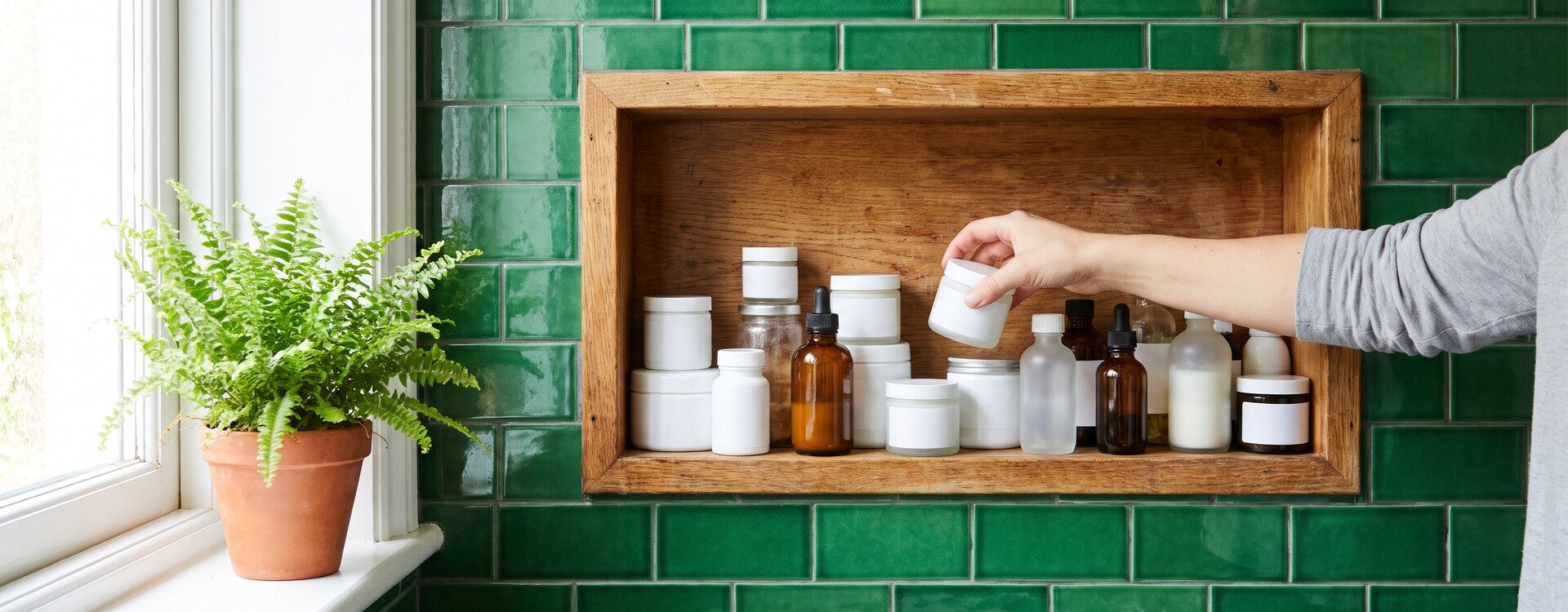
The bathroom shelf is full of bottles. Toner, essence, two serums, eye cream, day cream, night oil and a weekend mask. In the morning you need fifteen minutes before you've even had your coffee.
And your skin? It's no better than before. Sometimes it's worse.
Then you see a new video in which someone says you're missing one more step.
I make cosmetics, and every day I put ingredients together into creams, serums and oils. So I'll tell you something you might not expect from someone who sells products. Most skin doesn't need ten steps. It needs a few well-chosen ones that you'll use every day.
The term “Korean 10-step routine” was coined by Charlotte Cho, co-founder of the Korean beauty shop Soko Glam. She first published it in 2014 in ELLE magazine. Ten years later, in the same magazine, she herself wrote that the routine was never meant to be taken so literally, because hardly anyone can do ten steps every morning and every evening. Alongside that piece she suggested a simplified four-step routine.
In its 2021 trends report, Pinterest also coined a name for the opposite direction: skinimalism. Fewer layers on the face, and more skin that looks like skin.
Dermatologists have been saying this for a long time. The American Academy of Dermatology (AAD) describes the skincare order in four steps: wash your face, apply a medication or treatment if you use one, then moisturiser and/or sunscreen, and finally makeup, if you wear it. Dermatologist Marisa Garshick, in an AAD press release from October 2025 on skincare for children and teens, put it even more briefly: “More is not more in this case, and consistency matters more than a 10-step routine.”
This is the part you only see when you make a cream yourself.
Take our Immortelle face cream. The ingredient list includes immortelle hydrosol, grape seed oil and sunflower oil, immortelle macerate, an emulsifier that binds water and oil, glycerin and sorbitol, which attract moisture, immortelle essential oil, vitamin E, citric acid and preservatives.
So a single jar holds water, oil, something that attracts moisture, something that holds it in and something that protects the cream itself. Vitamin E keeps the oils from going rancid, citric acid adjusts the acidity of the cream, and the preservatives are there so that microorganisms don't grow in a cream that contains water.
Each of these ingredients is there for a reason and in an amount that matches the others. I wrote about how humectants, emollients and occlusives work as a team in my post on hyaluronic acid.
When five more products go on top of the cream, many of them bring their own water, and often their own glycerin and preservative too. Much of the work simply gets repeated.
When I make a new product, I don't choose ingredients because each one sounds good on its own. I choose them because they work together. Hyaluronic acid draws in water, and squalane helps keep it in the skin. The hydrosol provides the water base, and the oil provides softness.
A combination like that is designed and tested in a single formula.
The combination you build on your face from six different products is not. Each manufacturer has tested its own product. Nobody has tested that exact mix on your skin. Dermatologist Sean McGregor of Cleveland Clinic says: “The more products you use, the better the chances you're going to have side effects from them.”
Active ingredients are where you feel this fastest. Retinol, acids, vitamin C and acne treatments each have their place on their own. Layered one on top of another, the irritation adds up. That's why the AAD advises starting with one product, because several anti-ageing products at once can irritate the skin, and on irritated skin the signs of ageing look even more pronounced. If your dermatologist prescribes two treatments, ask how to spread them out. Often one goes on in the morning and the other in the evening.
You see the finished jar. Before it reaches the shelf, it is tested to see how it will behave over months and years.
Every cosmetic product in the European Union must have a safety assessment, and stability testing is part of it. The tests check whether the cream still has the same colour, scent and thickness after several months, whether the water separates from the oil, whether the acidity changes and whether the preservative keeps microorganisms under control.
To avoid waiting for years, samples are kept at a raised temperature. According to guidelines used in the industry, for a one-year shelf life the samples are kept at 40 °C for twelve weeks in an accelerated test, while the actual shelf life is confirmed by long-term tests at room temperature. On top of that come freeze–thaw cycles, a centrifuge that speeds up the separation of phases, and exposure to light. The packaging is checked too, because some ingredients react with plastic or with the lid.
This is where the shelf life comes from. If a product is stable for up to 30 months, the packaging must show a date. If it's stable for longer, the packaging carries a small open-jar symbol with the number of months you can use it for after opening.
I add one more step of my own. When a batch is finished, I pick out a few products from it at random and keep them as control samples.
And there's one practical point here. Every open bottle has its own clock. Ten open products means ten clocks ticking at the same time, and some of them expire before you've used them up.
If your skin has already turned red and reacts to everything, read the post on the damaged skin barrier. You'll also find a plan there for calming it down.
When you use several products, the order matters. The rule is simple: from the thinnest texture to the richest. A light serum under a cream reaches the skin, but on top of it, it barely does.
Morning
Evening
A medication prescribed by your dermatologist goes on straight after cleansing, unless they've told you otherwise.
The shortest version has three steps. Dr McGregor says exactly that: the minimum you need is a cleanser, a moisturiser and sunscreen. Everything else you add when you have a reason to.
In the evening, the 2FACED makeup remover butter can do the job for you. Coconut, almond and macadamia oils melt away makeup and SPF cream, and then rinse off with water. Dry skin often doesn't even need a second cleanse.
If your skin feels tight, two products are enough. The Hydrating duo is made up of a serum with hyaluronic acid and a cream with hyaluronic acid and squalane. The serum drenches your skin in moisture, and the cream holds it in.
Dry and mature skin does well with the Immortelle Ritual: a hydrosol, a cream and an oil serum with immortelle, layered from lightest to richest.
We no longer have an SPF cream in our range, so you'll need to choose one separately. In the morning it's the last step, and the only one that shouldn't drop out of your routine.
Less is almost always better when your skin is sensitive or reactive, when you're using a skin medication prescribed by a dermatologist, in winter while the heating is on, and for children and teenagers. For children, Dr Garshick recommends gentle cleansing, a fragrance-free moisturiser and sunscreen, while younger skin doesn't need retinol, vitamin C or exfoliating acids.
An extra step makes sense when you have a specific reason for it: your skin feels tight, so you add a hydrating serum, or you wear makeup in the evening, so you add an oil cleanse. One new product, a few weeks of patience, and only then the next one.
If you're struggling with acne, inflammation, redness that won't go away or dark spots, another bottle won't help. See a dermatologist.
A good routine doesn't have to be long. It has to be yours, one you'll keep up even when you're tired, a month from now and a year from now.

Prezzo più basso negli ultimi 30 giorni: 8,78 €
Prezzo al 02.05.2025.: 6,63 €


 Is fragrance-free skincare really better for your skin?
Hyaluronic acid not enough? What really keeps your skin hydrated?
Damaged skin barrier: how can you tell you've overdone your skincare?
Your skin feels dry even though you moisturise all the time? Here's why.
Why does your skin feel tight as soon as the heating goes on? An autumn routine in three steps