
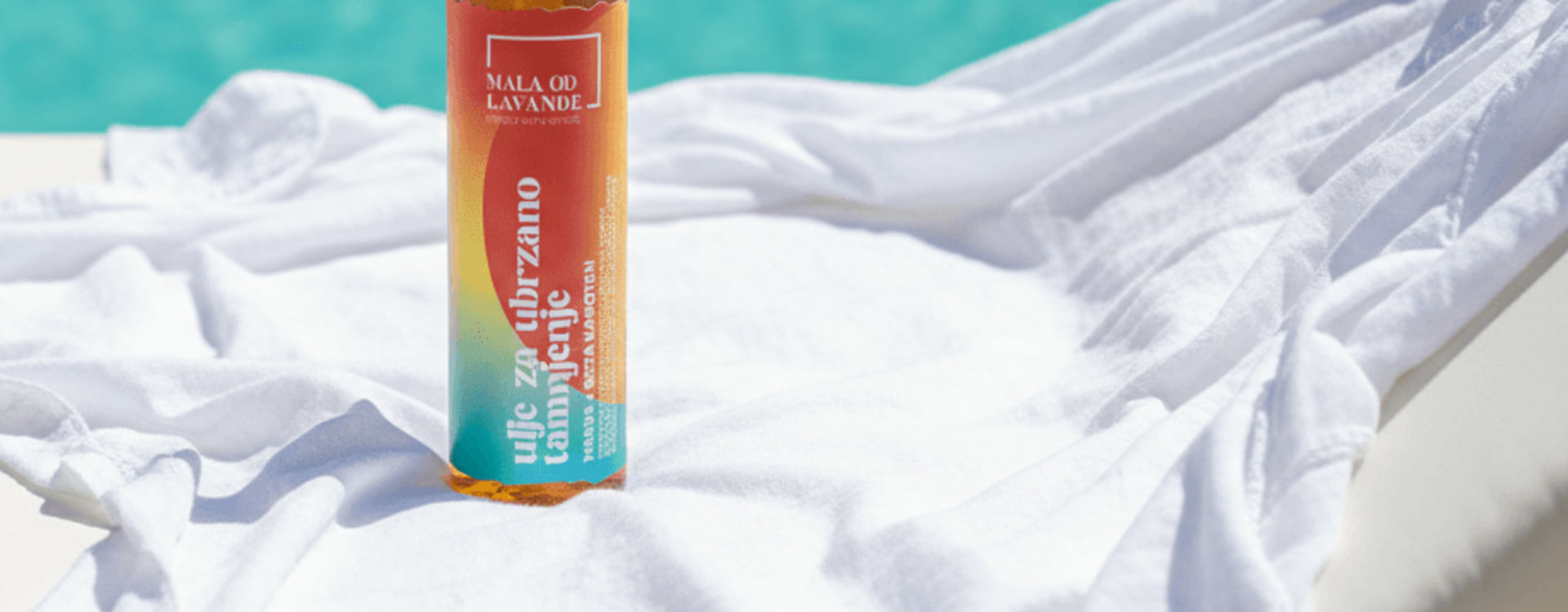

Tanning oil is not sun protection. And that is important to repeat.
Summer, sea, sun, bare shoulders, the smell of skin after the beach… All of that sounds wonderful. And it truly is wonderful.
But the sun is no joke.
Therefore, I must once again clearly state something that is also written on our carrot oil for accelerated tanning: it has no sun protection factor.
This means that this oil is not SPF. It is not sun protection. It is not a product that protects the skin from UV radiation. It is a skin care oil for faster tanning, but it does not replace sun protection factor.
And there's not much philosophy to it: if you use tanning oil, sun protection is still mandatory.
A Tanned Complexion Is Not Proof of Healthy Skin
I know, we all love that beautiful summer tan. The skin looks warmer, somehow fresher, more rested, as if we've just returned from vacation and everything in our life is in order.
But it's important to know what actually happens when skin tans.
Tanning is the skin's reaction to UV radiation exposure. In other words, the skin is defending itself. It tries to produce more pigment to protect itself from further damage. So, tanning is not a sign that the skin is “healthy and nourished by the sun,” but a sign that the skin has already received a message: I am exposed to radiation and I must defend myself.
This doesn't mean we have to lock ourselves indoors all summer and frantically run from every ray of sun. But it does mean we should have respect for the sun. Especially today, when we already know well how much UV radiation can affect the skin.
What Does the Sun Actually Do to the Skin?
Solar radiation is not just what we feel as warmth on the skin. The biggest problem for the skin is UV radiation, especially UVA and UVB rays.
We mostly associate UVB rays with sunburns. That's when we "just get a little red," and then in the evening realize we can't comfortably lean back in a chair. UVB is the main culprit for classic sunburns.
UVA rays are more insidious. They penetrate deeper into the skin and are associated with premature skin aging, loss of elasticity, wrinkles, pigmentation, and long-term damage. The problem is that UVA rays don't necessarily trigger an immediate dramatic red alarm on the skin, so people often think "nothing happened."
But it did happen.
The skin remembers. Maybe not today, maybe not tomorrow, but years of sun exposure are later visible through pigment spots, uneven complexion, dryness, skin thinning, wrinkles, and an increased risk of more serious skin changes.
Sunburn Is Not "I Just Overdid It a Little"
One of the worst sentences we tell ourselves in summer is: "Oh, it's fine, I just got a little burnt."
It's not fine.
A sunburn is a sign that the skin is damaged. If the skin is red, painful, hot to the touch, tight, or later peels, it means it has received too much UV radiation.
Skin peeling is not "tan renewal." It's the skin trying to get rid of damaged cells. And that's why sunburns should not be romanticized, ignored, or considered a normal part of summer.
Special care should be taken with children, people with lighter skin, people with many moles, those who burn easily, but also with everyone who thinks...I never burn, I just tan.
Just because someone doesn't burn easily doesn't mean UV radiation isn't affecting their skin.
Tanning Oil Is Not SPF
Our carrot oil for accelerated tanning is made for skin care and to help achieve a faster tan. But it has no sun protection factor.
- It does not protect from UV radiation.
- It does not prevent sunburns.
- It does not replace sunscreen with SPF.
- It should not be the only thing you apply before sun exposure.
And that's exactly why it clearly states on it that it has no sun protection factor.
Tanning oils are often perceived by people as "summer care," and that's okay if used wisely. The problem arises when tanning oil is used as if it were sun protection.
It is not.
Oil can nourish the skin, give it a beautiful glow, help the skin look more nourished and beautiful, but it cannot do the job of SPF.
If You Use Oil, SPF Is Still Mandatory
If you use tanning oil, sun protection factor must still be part of your routine.
And not symbolically.
Not like...I'll put a little SPF on my nose and shoulders, I applied it this morning so I'm good all day. Not like...I already have foundation so I don't need much.
Sun protection factor should be applied in a sufficient amount, evenly, and to all parts of the skin exposed to the sun. If you swim, sweat, towel dry, or are outdoors for an extended period, SPF should be reapplied according to the product instructions.
The most important thing to remember: oil and SPF are not mixed in the palm of your hand like a cocktail. SPF must have the opportunity to create an even protective layer on the skin. If you use oil in the same routine, let the products absorb nicely and do not dilute the sun protection factor with oil.
SPF is what does the protective job. Oil is care. These are two different roles.
"But Then I'll Tan Slower"
Maybe.
If you use a good sun protection factor, especially mineral protection or high SPF, it's possible you'll tan slower. And that's actually a good thing.
Because the goal is not to bake your skin in three days.
The goal is to return from the sea with skin that is not burnt, dehydrated, painful, and angry at you. A beautiful tan that comes slowly, with protection, is always better than quick tanning that ends in redness, peeling, and skin damage.
No intelligent person will prioritize a bronze tan over healthy skin.
A tanned complexion is beautiful. But healthy skin is more important.
Sun Protection Is Not Just SPF
This is very important: sun protection doesn't just mean applying cream.
SPF is important, but it's not a magic shield. The best protection is a combination of several things.
- Whenever possible, choose shade. Especially during the strongest part of the day. The sun is not the same at 8 AM and 1 PM. If you're on the beach, try to have natural shade, an umbrella, an awning, or at least a break from direct sun.
- Wear a hat or cap. Face, ears, scalp, and neck often suffer because we forget to protect them.
- Wear sunglasses with UV protection. The skin around the eyes is sensitive, and the eyes also need protection.
- If you are outside for a long time, light, breathable clothing can be better protection than constant exposure of bare skin. A linen shirt, sarong, light dress, a t-shirt over your shoulders while walking to the beach...all of this makes sense.
- And, of course, SPF. In sufficient quantity. Regularly. Without skimping.
The Most Common Mistakes We Make with the Sun
- The first mistake is that we apply sun protection factor only when we already arrive at the beach. In an ideal world, SPF is applied before sun exposure, calmly, evenly, without rushing and without sand already stuck to your legs.
- The second mistake is applying too little. Most people don't apply enough product to get the protection stated on the packaging. If you apply a thin, barely visible layer, you cannot expect full protection.
- The third mistake is forgetting to reapply. SPF is not a one-and-done application. Sweat, water, towels, clothes, and time all do their part.
- The fourth mistake is protecting only the face. Shoulders, décolletage, neck, ears, arms, feet, and the back of the legs very often get burnt because we simply overlook them.
- The fifth mistake is the belief that we don't need protection if it's cloudy. UV rays pass through clouds, so a cloudy day doesn't automatically mean a safe day for the skin.
- The sixth mistake is the classic one: I'm already tanned, now I don't need SPF. You do. Tanned skin is not an impenetrable shield.
What After Sun Exposure?
After sun exposure, the skin needs peace.
Even if you haven't gotten burnt, sun, salt, wind, sweat, and sea can dry out the skin. That's why after the beach, it's good to wash off salt and sweat from the skin, gently towel dry it, and apply something that restores comfort to the skin.
After-sun care products, hydrating gels, light creams, or Aloe vera gel can be incorporated into your routine. Aloe vera gel is particularly pleasant in summer as it provides a cooling and refreshing sensation, especially if kept in the fridge.
But importantly: after-sun care does not undo the damage from excessive sun exposure. If you are burnt, aloe vera or any after-sun product can relieve the feeling of discomfort, but it does not mean the damage is erased.
That's why it's always better to prevent than to remedy.
Where Does Carrot Oil Fit In?
Carrot oil for accelerated tanning makes the most sense as part of summer care, but not as protection.
You can use it when you want nourished, glowing, well-fed skin and when you want to support achieving a tanned complexion. But always with a smart approach to the sun.
That means: no midday frying. Not without SPF. No ignoring redness.
Tanning oil can be a wonderful summer product if you use it responsibly.
But if you use it as a substitute for protection, then you're using it incorrectly.
Summer Is Not a Competition to See Who Gets the Darkest Tan
Perhaps the most important change we can make is in our mindset.
Summer shouldn't be a competition to see who returns darkest from the sea. We don't have to prove we were on vacation by coming home three shades darker and with peeling shoulders.
Healthier skin, fewer sunburns, less forcing, more shade, more water, more breaks from the sun – that's a much better plan.
The sun can be wonderful. But only if we don't underestimate it.
So once again, as clearly as possible:
- Our carrot oil for accelerated tanning has no sun protection factor.
- It is not SPF.
- It does not protect from UV radiation.
- If you use it, sun protection factor is still mandatory.
- A tanned complexion is beautiful, but healthy skin is more important.
And that's it. Summer can be beautiful even without burnt skin.