
There are no more items in your cart

You wash your face in the morning, put on your cream and for a moment everything feels fine. By noon your skin is tight again. In the evening you apply a thicker layer, and the next morning you wake up with the same feeling. So you buy a richer cream. And then another one.
And your skin still wants more.
If this sounds familiar, you are not alone. The problem is almost never that you don't use enough cream. Much more often your skin is getting what it doesn't need, or something in your daily routine takes away exactly what the cream is trying to give back.
When your skin feels tight, the first thought is that it needs more. One more layer, a richer formula, applying it more often. It sounds logical, but skin doesn't follow the rule "the more, the better".
If the cream doesn't contain what your skin is missing, a thicker layer simply sits on the surface for longer. Your face feels greasy to the touch, and underneath it is still dry or thirsty. That's why the more important question is what your skin is missing, and only then how much cream to use.
Dry skin and dehydrated skin sound the same, but they are not the same thing.
Dry skin lacks oil, that is, the lipids that keep it soft and protected. It is a skin type and usually stays that way all year round. Dehydrated skin lacks water. It is a condition that comes and goes, and even oily skin can have it.
The easiest way to picture it: dry skin is hungry, dehydrated skin is thirsty. A glass of water won't help hungry skin, and a meal won't help thirsty skin. Skin is often both at the same time, especially once the heating season starts.
We explained the difference in detail in our article Dry vs. dehydrated skin, so here we go one step further: why the cream you use every day may not be answering the right question.
Dermatologists divide the ingredients of moisturising creams into three groups, according to what they do. This is also how they are described in a 2017 review of moisturisers (Purnamawati and colleagues).
When one of these jobs is missing, the cream only does half the work.
This is where the most common confusion starts. When skin is thirsty, we reach for the richest cream we have. It really does hold moisture in, but if there isn't enough water in the skin, there is nothing to hold. The skin stays tight under a greasy layer.
It also works the other way round. A light gel or a serum with hyaluronic acid brings moisture to the skin, but if nothing seals that moisture in, it quickly evaporates. Dry skin then stays rough and coarse, because the oil it lacks hasn't been replaced.
That's why the order makes sense: first what brings water, then what keeps it.
Sometimes the cream is perfectly good, but daily habits undermine it. The American Academy of Dermatology (AAD) gives a few simple tips for dry skin, and many of us do the exact opposite:
None of these changes costs anything, and each one makes the cream's job easier.
You don't need a test or a device. It's enough to watch how your skin behaves for a few days.
Your skin is probably missing oil if it is rough, flakes on the cheeks or around the nose, rarely gets shiny during the day and has always been like that.
Your skin is probably missing water if it feels tight right after washing, has fine lines that disappear when you apply cream, looks tired and dull, and can be oily in the T-zone at the same time.
If you recognise both, that's not a mistake. Skin like that needs both water and protection.
For thirsty skin, the simplest routine has two steps. On clean, slightly damp skin, first apply a hydrating serum, and then a cream that keeps the moisture in.
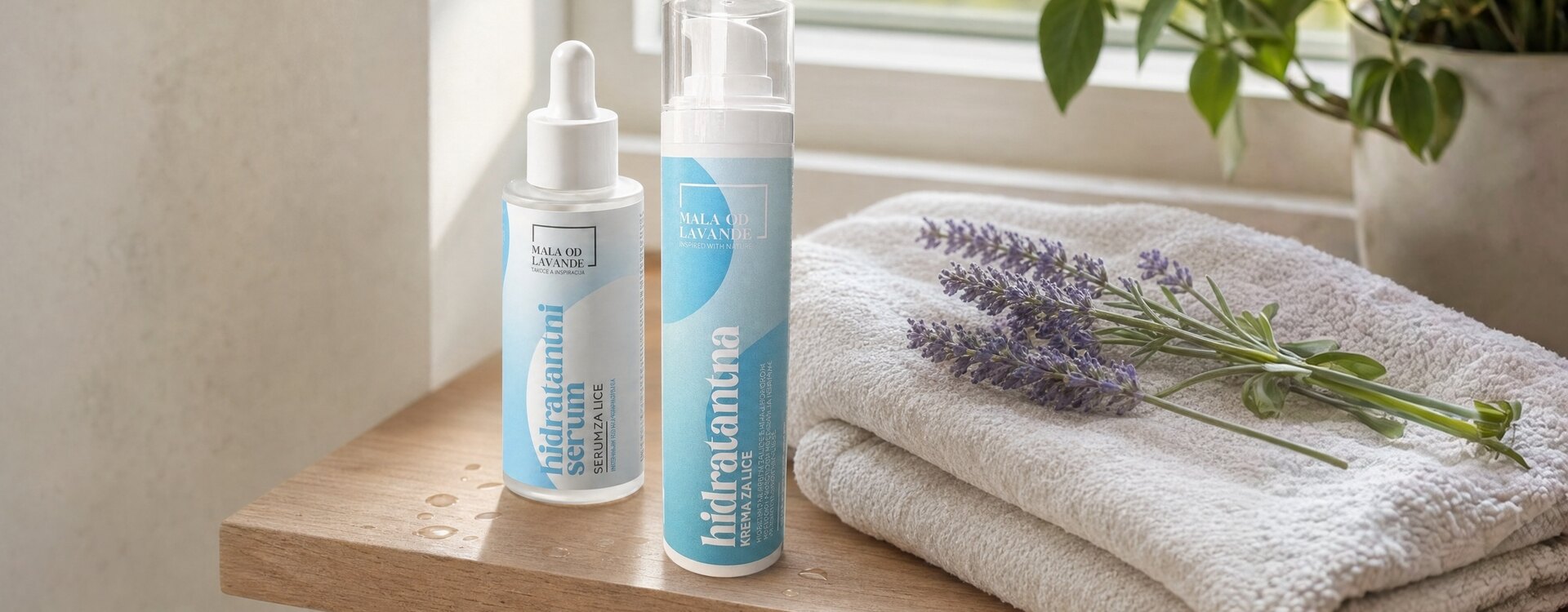
Our hydrating face serum is based on aloe vera juice, with hyaluronic acid, glycerin and panthenol. It is light and fragrance-free, so it also suits sensitive skin. On top of it goes the hydrating cream with hyaluronic acid and squalane: hyaluronic acid binds moisture, and squalane blends with the skin and helps that moisture stay where it is.
If your skin is more hungry than thirsty, a richer cream on slightly damp skin, morning and evening, and gentler cleansing are enough.
You don't need ten products. You need the right two, applied at the right time.
Cosmetics care for the skin, but they don't treat it. If the dryness doesn't go away despite your care, or if your skin cracks, bleeds, itches badly or turns red in patches, see a dermatologist. Dryness like that can be caused by a condition that needs more than a cream.
For most of us, the answer is simpler. The right cream on slightly damp skin and gentler cleansing. Once you have that sorted, you no longer need to put cream on your face ten times a day.

 Why does your skin feel tight as soon as the heating goes on? An autumn routine in three steps
From 1 to 11 October we are taking a short holiday
Why Does a Single Scent Take Us Back to Childhood in a Second?
Did Your Products Arrive Warm? Don't Worry, That's Perfectly Normal.
They're Hot Too: How to Help Your Dog Survive Summer Without the Drama
Why does your skin feel tight as soon as the heating goes on? An autumn routine in three steps
From 1 to 11 October we are taking a short holiday
Why Does a Single Scent Take Us Back to Childhood in a Second?
Did Your Products Arrive Warm? Don't Worry, That's Perfectly Normal.
They're Hot Too: How to Help Your Dog Survive Summer Without the Drama