
There are no more items in your cart

There are ingredients in cosmetics that come and go with trends. They appear for one season, promise a lot, and then slowly fade out of focus. Shea butter is not one of them.
It has been present in skincare for decades, and its popularity is not a result of marketing, but rather the experience of people who use it. Many discover it quite by chance through a hand cream, lip balm, or body butter, and only later realize how truly versatile it is.
Shea butter is one of those ingredients that doesn't promise miracles. It doesn't promise perfect skin overnight. What it offers is something much simpler and more realistic: protection, nourishment, and a feeling of comfort on the skin.
In the world of natural cosmetics, this is often precisely what the skin needs most.
Shea butter is obtained from the fruits of a tree that grows in West and Central Africa. These trees grow slowly and can live for decades, and the fruits are traditionally collected by hand.
The process of obtaining the butter is relatively simple but requires a lot of labor. The fruits are first dried, then the hard shell is removed, and the inner kernel is ground and processed until a rich, thick butter is obtained from it.
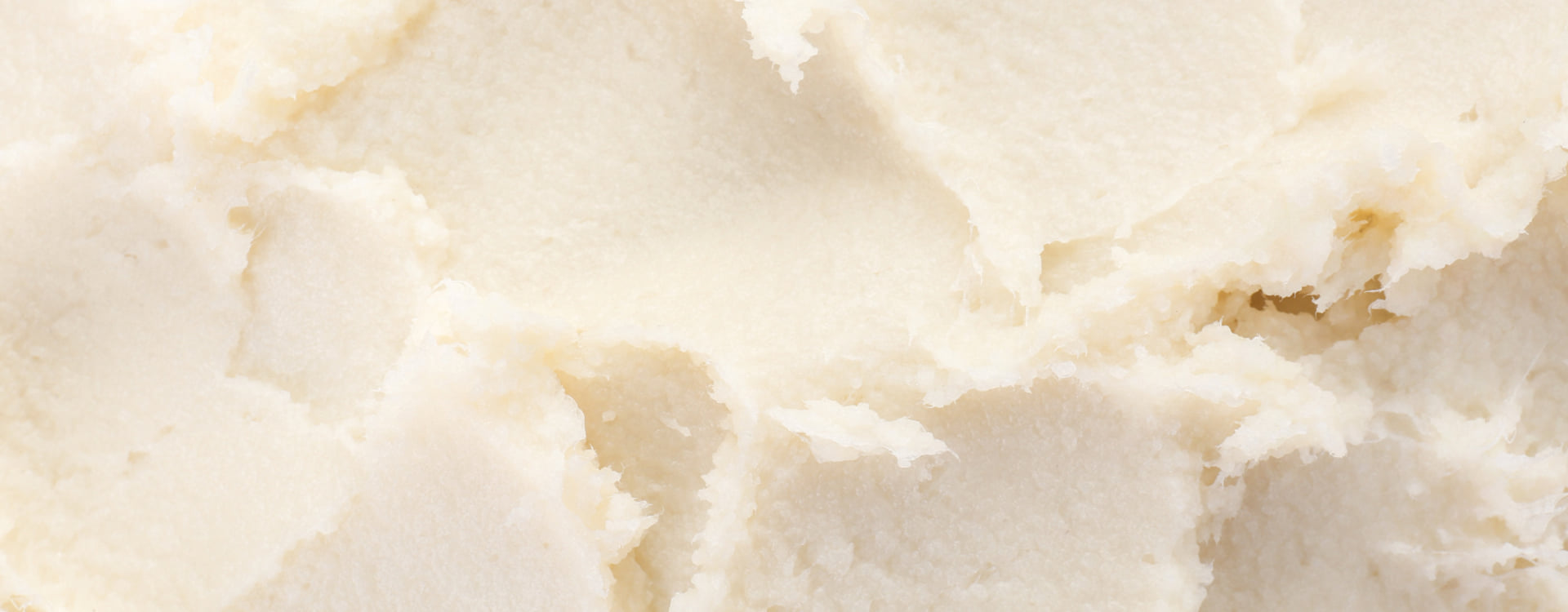
In its natural form, shea butter has a firm texture but melts quickly upon contact with the skin. This change in texture is one of the reasons why it is so often used in cosmetics; it is easy to apply and creates a feeling of protection on the skin.
Skin loses moisture daily. This is a natural process that occurs due to the environment, heating, cold, wind, or simply due to lifestyle.
Because of this, many skincare products have the same goal: to help the skin retain moisture and prevent dryness.
Shea butter plays a special role in this. Its natural composition is rich in fatty acids that help create a protective layer on the skin. This layer does not "lock in" the skin, but helps it retain moisture and a feeling of softness.
That's why shea butter is often used in products intended for dry skin. People who feel skin tightness after showering or during colder months often notice that products with shea butter provide a longer-lasting feeling of comfort.
It is important to emphasize that in cosmetics, we are talking about skin care, not medicinal effects. Shea butter is not a medicine, but it can be a very useful part of a daily skincare routine.
One of the more interesting things about shea butter is its versatility. It can be used in multiple ways in different formulations.
Most commonly, it is found in body care products because it helps soften the skin and provide a feeling of protection. It is especially popular in products for hands, feet, and body, as these are parts of the skin that are often exposed to external influences.
Many also like it in lip products because it provides a feeling of nourishment without excessive heaviness on the skin.
In colder months, shea butter often becomes one of the main ingredients in creams designed to protect the skin from wind and cold. When the skin is exposed to low temperatures, it can easily become dry and sensitive, and products rich in plant butters can help restore a feeling of comfort.
When talking about shea butter, it is often assumed that every product is the same. In reality, quality differences can be significant.
Natural, unrefined shea butter usually has a mild creamy or slightly yellowish color and a characteristic nutty scent. This scent is not strong, but it is recognizable and often a sign that the butter has not undergone intense processing.
Refined shea butter, on the other hand, may have a more neutral scent and a lighter color because it has undergone additional processing. Such butter may be more stable in some formulations, but it is often used for technological reasons.
In quality cosmetic formulations, the balance between ingredients, product stability, and how the product behaves on the skin is important.
Shea butter is a naturally rich ingredient and is therefore typically used in smaller quantities.
It is most often applied after showering, when the skin is still slightly damp. At that moment, products spread more easily and distribute better on the skin.
With products containing shea butter, many people notice that a smaller amount is sufficient compared to lighter formulations. This is normal because it is an ingredient with a rich texture.
It is precisely this concentration that often gives the impression that the product "lasts longer," as less is needed for a single application.
In the world of cosmetics, complex skincare routines are often discussed. However, many people eventually realize that simplicity is actually what the skin responds to best.
One quality product that provides a feeling of comfort on the skin can often be more valuable than ten products that promise quick results.
Shea butter is precisely such an ingredient. It is not spectacular in terms of marketing, but it is reliable. Its value lies in providing the skin with what it often needs most: protection, nourishment, and a feeling of softness.
Natural cosmetics have been gaining popularity in recent years. People want simpler formulations, understandable ingredients, and products that don't try to be everything at once.
In this context, shea butter retains a special place. Its history of use, natural composition, and versatility make it an ingredient that many natural cosmetic manufacturers repeatedly return to.
And precisely for this reason, despite all the new trends in cosmetics, shea butter continues to be one of the foundations of natural skincare.

Lowest price in the last 30 days: €9.28
Cijena 02.05.2025.: 7,75 €


 From 1 to 11 October we are taking a short holiday
Why Does a Single Scent Take Us Back to Childhood in a Second?
Did Your Products Arrive Warm? Don't Worry, That's Perfectly Normal.
They're Hot Too: How to Help Your Dog Survive Summer Without the Drama
Dry vs. dehydrated skin - is not the same
From 1 to 11 October we are taking a short holiday
Why Does a Single Scent Take Us Back to Childhood in a Second?
Did Your Products Arrive Warm? Don't Worry, That's Perfectly Normal.
They're Hot Too: How to Help Your Dog Survive Summer Without the Drama
Dry vs. dehydrated skin - is not the same