Hrvatski
There are no more items in your cart



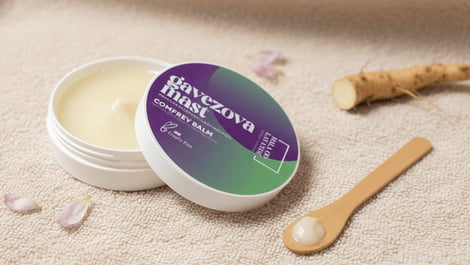
There are products that come and go, and then there are those that remain as a small home ritual. Comfrey ointment falls into the latter category. It's not a recent trend, but rather that type of simple, grounded care that our grandmothers kept in their drawer alongside plasters, chamomile, and something to rub on when things felt tight.
And let's be clear right away: comfrey ointment is not a medicine and does not replace medical treatment. But as part of a skincare routine, it's a go-to for many when they want a feeling of comfort, softer skin, and care for areas that tend to be dry, rough, or tired from everyday life.
Below is everything you need to know: what comfrey is, why it's so present in tradition, how comfrey ointment is most commonly used in care, and how to choose a quality product and use it wisely.
Comfrey is a plant that grows in moist habitats and is often mentioned in folk tradition. Our grandmothers were practical: when they discovered something that made the skin feel good and kept it under control, it stayed in use.
In traditional recipes, comfrey was often macerated in lard, and then an ointment was made from this macerate with wax or butters. Such preparations were simple, yet rich, pleasantly greasy, and ideal for skin massage.
Today, comfrey is still used in cosmetic formulas, most often as a root macerate or extract, in products intended for body care.
If comfrey ointment had a personality, it would be that friend who covers you with a blanket and says: "Let's take it easy." The reason is mainly that such ointments are:
In practice, people most often love comfrey ointment for the feeling after application: the skin is nourished, softer, and calmer to the touch.
These are the most common uses, without any promises to solve problems, but as routine care:
When skin feels tight after showering, in winter, from heating, or wind, a rich ointment can be great as a final step in your routine.
Tip: it works best on slightly damp skin (after showering, before you completely dry off).
If you have "turtle heels" as Zijah Sokolovic says :) and elbows that are always a step ahead of the rest of your body in terms of dryness – comfrey ointment is often a choice because it's greasy, protective, and long-lasting.
Tip: apply a thicker layer in the evening and put on cotton socks.
Many use it as part of a massage after walking, exercising, or working in the garden, as it provides a good and pleasant feeling on the skin.
Tip: in this case, apply a smaller amount and massage longer – more as a ritual.
Hands can become rough from soap, cold, and everything the day brings. The ointment is practical in the evening as a "night glove."
Tip: a thin layer overnight, and something lighter during the day (so you don't smear everything you touch).
Yes, natural is great, but natural is not the same as suitable for everyone, always. Here are some smart rules:
If you have any doubt about skin reactions, it's smartest to discontinue use and choose a milder care option.
This is the part that makes the difference between "eh, it's greasy" and "this is truly comfortable and I use it regularly."
Look for clear, understandable ingredients:
If you see too many perfumes and all sorts of things, and you have sensitive skin, it's better to skip it.
A good ointment melts on contact. It should be persistent, as that is its role: lasting protection and care.
With natural ointments, the scent often comes from vegetable oils and macerates, not from intense fragrances. If the scent is too much for you, there's a good chance you'll quickly tire of it.
If it's in a jar, use a clean spatula or clean hands, especially if you carry it in your bag or use it after a workout.
Not quite. Ointment is usually greasier and heavier than cream. Creams have more water and absorb faster. Ointment works more like a protective layer and locks in moisture.
Most often in the evening, or after showering. During the day, only if you don't mind a greasier feeling.
If your skin reacts well, many use it regularly, especially in winter. But for sensitive skin, it's better to start gradually (2–3 times a week) and observe how it suits you.
Possibly, depending on the amount. The trick is a thin layer and application to damp skin.
Comfrey ointment is a classic because it's simple and does its job in terms of skin care and comfort. There's no need to make a miracle out of it or promise the impossible. If you want a rich, long-lasting product for a massage ritual, dry body parts, and winter care, comfrey ointment is one of those traditional choices that have survived generations for a reason.